
Latest Read: Mercury Service Manual 4/5/102cc Sailpower
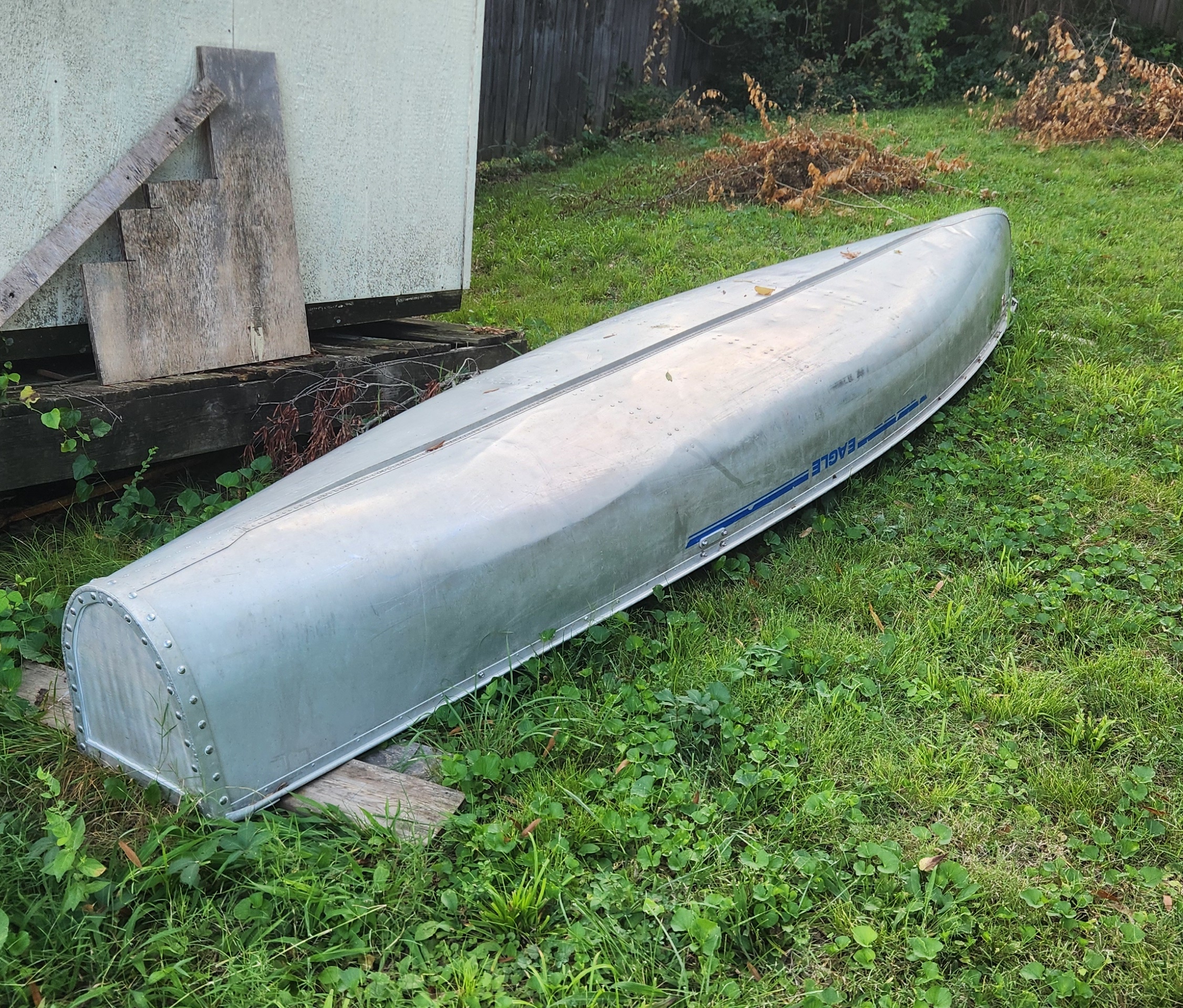
I recently bought a 17 foot Grumman Eagle flat stern canoe off of Marketplace. It’s huge, but it sits on the RAV4 like a dream. I’ve floated it and it does float nicely despite a pretty significant patch job on the flat stern. The flat stern may be an aftermarket job. this is all to say that the canoe is everything you could want for the price of a couple hundred bucks and some paddles. There’s really only one thing to do that can improve this already immaculate 40 year old canoe. We’re going to be putting a motor on the back of it so that my sweet girlfriend doesn’t have to paddle it up and down river with me.
So I bought a 5 horsepower outboard motor for $200 with a broken lower unit. The propeller shaft housing (also called the bearing housing) was ripped off of the lower unit housing at the bolt, I suspect the kid that had it before me ran it into something hard and instead of the prop taking the hit the housing did. After a bit of research I bought an aftermarket replacement part online for $25 and replaced it. It was a minor struggle to get the lower unit back into the engine but after some consultation from my girlfriend I got everything assembled and ready for the motor to start. This is where things really begin.
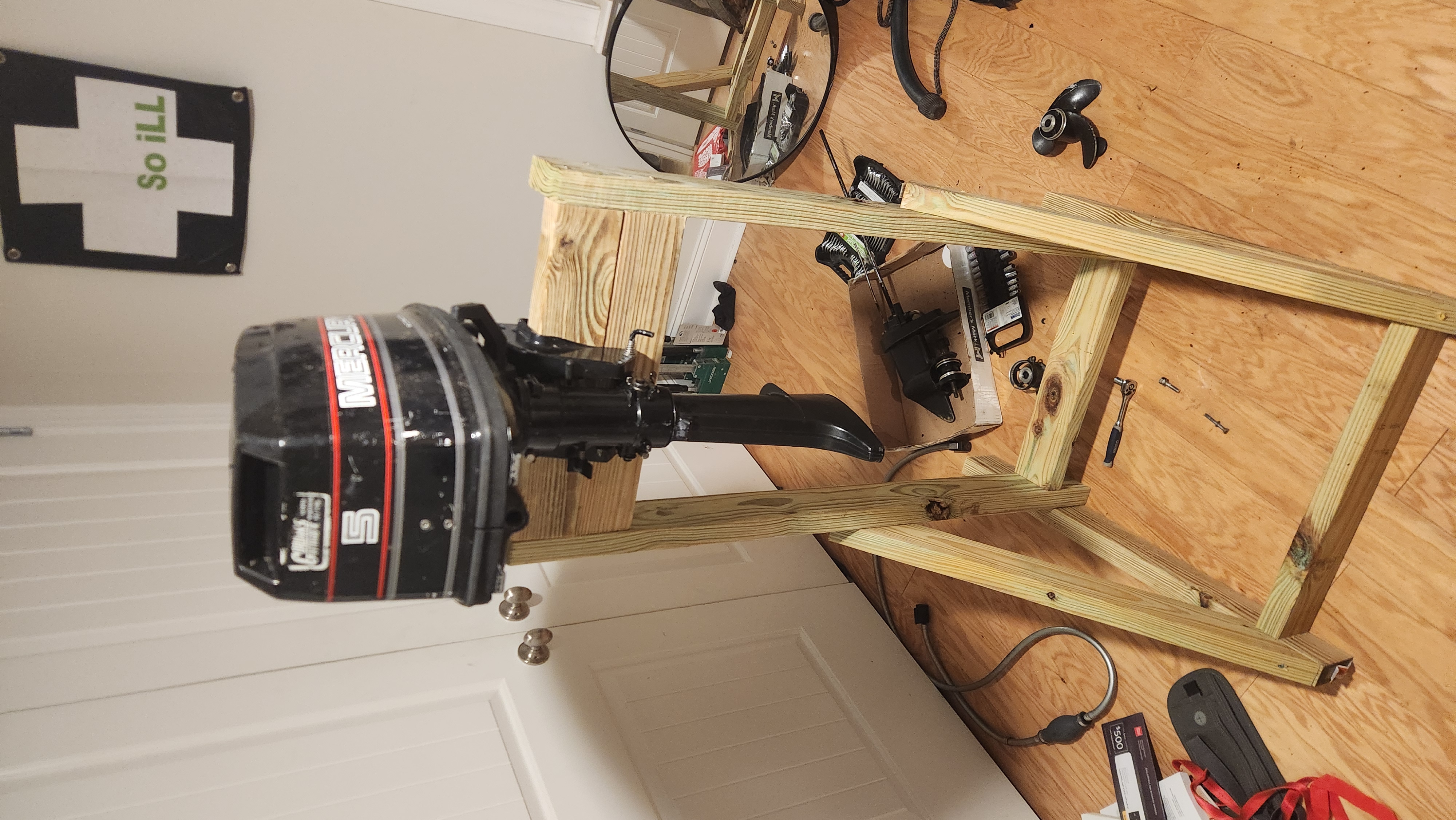
I’ve never started a motor that wasn’t in a car or a lawnmower so a two-stroke on an outboard motor was completely new to me. Despite my lack of experience I pumped the external tank primer and ripped the recoil starter and it came up easily only to die after about 20 seconds. Hmm… If you know anything about motors you probably have some ideas already as to what could be causing this problem. An engine needs 3 things to run, fuel, air, and spark. The spark is handled by the spark plug and since it starts up we can reasonably assume we have a solid spark. On modern car engines we have electronic fuel and air mixing but on older and smaller motors like this one we have a carburetor that feeds the cylinder the appropriate mix. Somewhere before the fuel/air mixture gets into the cylinder we are getting a bad ratio. This causes our motor to bog down and eventually die. This can be caused by a number of things but we start at the carburetor.
The carb is what mixes your fuel and air as you pull your throttle higher and lower. Old fuel can stick around in the carb and turn to varnish which clogs the very small holes in your carburetor and changes the amount of fuel that can come through your carb. So I take apart the carb and wouldn’t you know it? It’s clean. No residue to be found. That’s strange. I spray it out with carb cleaner and put it back on the motor just to be safe. Pull the cord, nothing. Ok where else can we get air introduced where it shouldn’t be? These fuel lines are probably over 30 years old and they’re rotting off of the so let’s try changing those out next.
A trip to O’Reilly’s, learn how to replace fuel lines (it’s not hard), figure out how to use the hose clamps , put the fuel filter back on, start the motor. And? Nothing. Still dying.
Hmm. The carb is probably 30 years old and the built-in fuel pumnp relies on very thin rubber layers to make a diaphram that pulls and pushes fuel into the carb. If your fuel pump has gone bad you can hand pump your primer bulb to get fuel into the carb but once the carb burns all of this fuel you run out and the engine dies. Sounds promising. A new gasket/diaphram kit is $30 but a whole new carb is $50. I get a brand new carb on Ebay and wait a few days. In the meantime I read the sections in my manual on taking apart the cylinder and piston, check the compression (compression is great), and replace the spark plug all according to the handy manual.
New carb is installed and I dig into the section titled “Fuel System -> Carburetor Adjustments -> Approximate Initial Settings” We set these initial settings and … hang on … we’ve got a decently smooth idle for longer than usual. Ok maybe I didn’t adjust the original carb well enough or maybe the new one is the trick. Who cares, it’s better now. The idle is choppy so we push the idle speed screw more. Better. Low Speed Mixture screw gets pulled back for a richer mixture. Ok even better now. We’re starting to look better and better. But hang on, we’re not out of the woods yet. It dies when we put it in gear and sometimes it stutters when I bring it back down to idle.
Well it’s time for a confession. I thought (erringly) that gas station fuel was made of 100% gasoline, why would they call it gasoline if it wasn’t all gasoline? It’s not the case. Gasoline you put in your car has 10% ethanol in it which means it’s less explosive than 100% gasoline. Take a wild guess what I’ve been putting through my motor this entire time. Hmm. Ok well our low power could have something to do with this. And what’s that? Our external gas tank fuel line is leaking and the clamp is loose? Oh ok. Maybe we’re getting somewhere.
Finally I grab the external fuel line. It squishes in my hand. Not good, fuel line should be pretty rigid. Ok, I’ll cut it open and see what it looks like inside before I buy a whole new external fuel kit. Oh no. the inner lining is completely collapsed. The engine has been turning on with my priming and then failing because it couldn’t pull a strong enough vacuum through the collapsed lining. I cut out the collapsed section and we try it again. Runs perfectly. Runs like a dream. Runs like you wouldn’t believe.
This was a completely foreign experiment for me. I’d never even started an engine much less fixed one and now I’ve changed out everything short of the cylinder, rebuild a lower unit, and learned alot about outboard motors. And all under about $400 for parts, fluids, and the motor itself.